It's easy to glance at a supplement label, see a handful of unfamiliar names, and move on. But if you're going to take something every night for months, it's worth five minutes to actually understand what's in it. Here's what's on the YuSleep label, ingredient by ingredient, based on the supplement facts panel.
Reading the Label
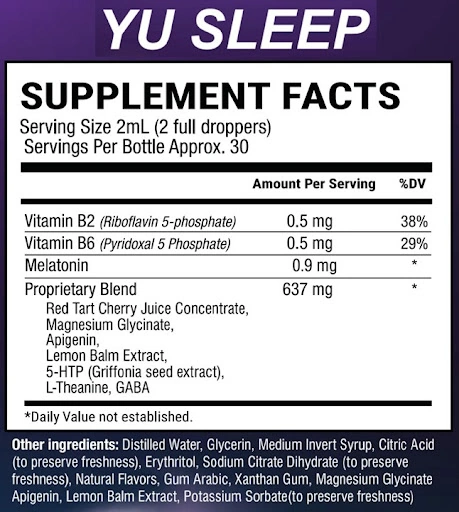
Each 2mL serving (two full droppers) of YuSleep contains four labeled items: Vitamin B2, Vitamin B6, Melatonin, and a 637mg "Proprietary Blend" made up of seven additional ingredients. The first three have individual milligram amounts listed. The proprietary blend is disclosed as a combined total weight, with its seven components listed in descending order by amount but without individual milligram breakdowns — a common, though not ideal, practice across the supplement industry.
Melatonin — 0.9mg
This is the headline ingredient, and also the one where YuSleep takes its most distinctive stance. Many melatonin products on the market use 3mg, 5mg, or even 10mg per serving. YuSleep uses 0.9mg — less than a tenth of the higher end of that range. Melatonin is a hormone your body produces naturally in response to darkness, signaling that it's time to wind down. Supplementing with it is thought to help reinforce that signal, particularly for people whose natural rhythm has been disrupted by screens, irregular schedules, or stress. Lower doses are generally associated with a gentler nudge to the system rather than a forced sedation, which may explain why some people report less next-day grogginess with lower-dose formulas.
Vitamin B2 & B6 — 0.5mg Each
Riboflavin (B2) and Pyridoxal 5-Phosphate, an active form of B6, both play supporting roles in the body's nervous system function and energy metabolism. B6 in particular is involved in the synthesis of several neurotransmitters, including serotonin — which the body can convert into melatonin. Including both vitamins alongside melatonin is a common formulation strategy meant to support the body's own production pathway, not just deliver melatonin directly.
Inside the 637mg Proprietary Blend
This is where most of the formula's total weight lives. Here's each ingredient and what it's generally understood to contribute:
- Red Tart Cherry Juice Concentrate — Tart cherries are a natural dietary source of melatonin and have been studied in relation to sleep-wake cycle support, making this a food-based complement to the supplemental melatonin already in the formula.
- Magnesium Glycinate — A well-absorbed, gentle form of magnesium. Magnesium plays a role in muscle relaxation and nervous system regulation, and glycinate is generally considered one of the more stomach-friendly forms.
- Apigenin — A plant flavonoid found in chamomile, among other plants. It's the compound most associated with chamomile's traditional reputation as a calming, bedtime herb.
- Lemon Balm Extract — A member of the mint family with a long history of traditional use for calm and relaxation, often paired with chamomile or valerian in herbal sleep blends.
- 5-HTP (from Griffonia Seed Extract) — A precursor the body can convert into serotonin, which is itself upstream of melatonin production. It's one of the more researched natural sleep-support compounds, though doses vary widely across studies.
- L-Theanine — An amino acid found naturally in tea leaves, associated with promoting alpha brain wave activity — a state linked to calm, relaxed alertness rather than drowsiness. It's commonly paired with GABA in sleep formulas.
- GABA — The brain's primary inhibitory neurotransmitter, meaning its job is to calm down overactive neural signaling. Oral GABA supplements are a subject of ongoing research regarding how effectively they cross into the central nervous system, though they remain a popular inclusion in calming formulas.
A Note on Proprietary Blend Doses
To be fully transparent: because these seven ingredients are combined into a single 637mg blend rather than individually dosed, there's no way to know from the label alone exactly how much GABA, 5-HTP, or L-theanine you're actually getting. Some of these ingredients have published research using doses in the hundreds of milligrams for a single ingredient alone — meaning it's possible some components of this blend are present in smaller amounts than research doses, simply because they're sharing a 637mg total with six other ingredients. This isn't unique to YuSleep — it's standard practice across much of the supplement industry — but it's worth knowing if ingredient-level dosing precision matters to you.
The Inactive Ingredients Matter Too
Beyond the active formula, the "other ingredients" list is worth a quick look, since these make up the liquid base and preservation system rather than contributing to the sleep-support effect directly: distilled water, glycerin, medium invert syrup, citric acid, erythritol, sodium citrate dihydrate, natural flavors, gum arabic, xanthan gum, and potassium sorbate. Glycerin and gum arabic give the liquid its texture and mouthfeel; citric acid and sodium citrate help stabilize pH and preserve freshness; erythritol is a sugar alcohol used for a touch of sweetness without a significant calorie or blood-sugar impact. If you have specific sensitivities to any of these — for example, a sugar alcohol sensitivity to erythritol — this is the section of the label to check.
How This Formula Compares to a Typical Single-Ingredient Product
Most drugstore melatonin products are exactly that: melatonin, and not much else, often in a much higher dose. YuSleep's approach — combining a smaller melatonin dose with nine supporting ingredients — is sometimes described in the industry as a "synergistic" or "multi-pathway" formula, on the theory that supporting several biological mechanisms at once produces a more well-rounded effect than maximizing a single one. Whether that theory holds up for any individual user is impossible to promise, but it does explain the underlying formulation logic if you've been wondering why the melatonin number looks so different from what you're used to seeing.
Questions Worth Asking Before You Buy Any Sleep Supplement
Regardless of which product you're considering, a few questions are worth running through:
- Is the melatonin dose (if any) clearly stated in milligrams, not just "included"?
- Are other active ingredients individually dosed, or bundled into a proprietary blend?
- Does the company disclose full inactive ingredients, including allergens and sweeteners?
- Is there a clear, time-bound guarantee if the product doesn't work for you?
- Does the marketing set a realistic timeline, or promise dramatic results in days?
Running any sleep supplement through this checklist — including this one — is a reasonable way to make an informed decision rather than a purely marketing-driven one.
Storage and Shelf Life
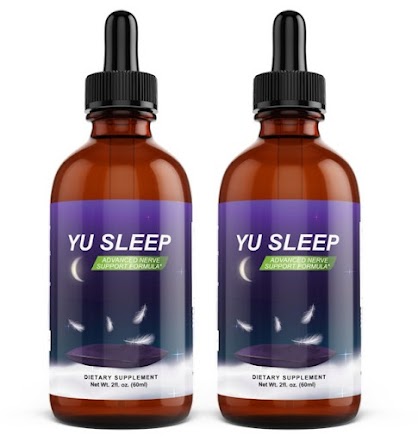
Liquid supplements have different storage considerations than capsules or tablets. Amber glass bottles, like the one YuSleep ships in, help protect light-sensitive compounds such as melatonin and the botanical extracts from degradation caused by UV exposure. Keeping the bottle in a cool, dark place — a bathroom cabinet or bedside drawer rather than a sunny windowsill — helps preserve potency over the roughly 30-day life of an opened bottle. If you notice a significant change in color, smell, or consistency before that window, it's a reasonable signal to check with the manufacturer rather than continue using it.
Can You Adjust the Dose?
Because YuSleep is liquid rather than a fixed-dose capsule, there's some flexibility to start with a smaller amount — for example, one dropper instead of two — if you're sensitive to supplements generally or simply want to gauge your body's response before committing to the full serving. This is one practical advantage of the liquid format over a capsule, where the full dose is fixed regardless of your preference. That said, any adjustment should stay within reasonable bounds of the labeled serving size, and significant changes are worth discussing with a doctor first, particularly if you're taking other medications.
The Bottom Line
The formula's overall design philosophy is coherent: rather than relying on one powerful sedative ingredient, it spreads support across multiple angles — a small direct dose of melatonin, nutrients that support the body's own melatonin production, and a blend of calming botanicals with long traditional (and in some cases researched) use. Whether that adds up to a noticeably different experience than a single higher-dose melatonin product is something only your own body, over a few consistent weeks, can really answer.